
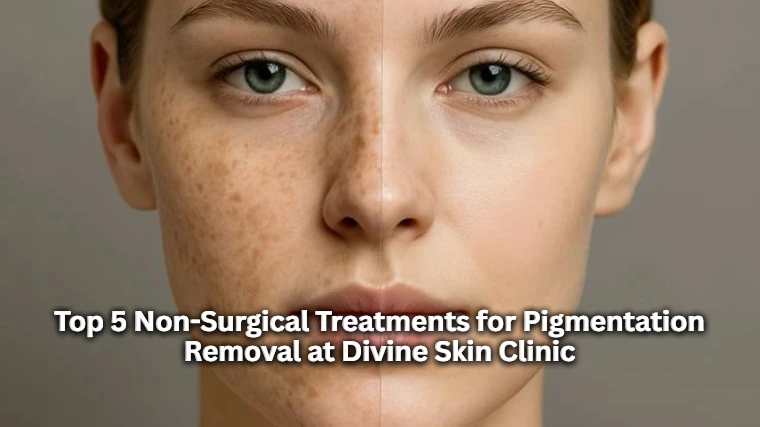
Pigmentation is a problem that many people have with their skin. It can show up as spots, uneven skin tone, sun spots, melasma or marks that are left after acne. The reasons for pigmentation can be different such as being in the sun too much, changes in hormones, inflammation or skin injury. To treat pigmentation you need to know what type it is and what is causing it. Dr. Zainab Safderi, best dermatologist in Indore, says that the best way to treat pigmentation is to make a plan that’s just for the patient, based on their skin type, the pattern of the pigmentation and the overall condition of their skin.
At Divine Skin Clinic, there are treatments for pigmentation that do not require surgery. These treatments can help make patches and uneven skin tone look better. Here are five options that people can consider after a doctor has looked at their skin.
Table of Contents
1. Chemical Peels
Chemical peels are used to treat pigmentation that’s close to the surface of the skin and uneven skin tone. When you get a chemical peel a special solution is put on your skin to remove the layers and make your skin look fresher. Your dermatologist will choose a solution that’s right for your skin, such as glycolic acid or salicylic acid.
Chemical peels can be helpful for pigmentation that is caused by the sun marks that are left after acne and some cases of melasma. The doctor needs to be careful when choosing the strength and type of peel for people with Indian skin tones because treatments that are too strong can make the pigmentation worse. If you follow the right treatment plan that an experienced dermatologist has made for you your skin can start to look brighter and smoother over time.
2. Laser Toning and Pigment Lasers
Laser treatments are used to target the pigment in the skin. Depending on the type of pigmentation and the technology that is used the laser can help break down the pigment so that it’s not evidently visible.
Laser toning and other laser treatments can be used to treat sun spots, uneven pigmentation and dark patches that do not go away. However, laser treatments are not right for every type of pigmentation. The results depend on the type of skin you have and how deep the pigment is in your skin.
It is very important to have a doctor look at your skin before you get a laser treatment because some laser treatments can cause pigmentation after the treatment. This is why the doctor needs to make a plan that’s just for you, based on your skin.
3. Intense Pulsed Light Therapy
Intense Pulsed Light or IPL uses a light to target areas of the skin that have too much pigment. It can be helpful for treating sun damage, freckles and brown spots that are close to the surface of the skin.
IPL can also help make skin that has been damaged by the sun look better. However it may not be right for every patient especially if the pigmentation is deep in the skin or if you have melasma.
A dermatologist can look at your skin and decide if IPL is a good option for you or if you should try a different treatment.
4. Microneedling for Pigmentation
Microneedling is a treatment that uses small needles to make tiny holes in the skin. It is often used to treat acne scars, uneven skin texture and skin tone problems. It can also be used to treat some types of pigmentation such as melasma.
In some cases, microneedling can be combined with creams that a dermatologist has chosen as part of a plan to treat pigmentation. The number of treatments you need will depend on how bad the pigmentation is, the type of skin you have and how your skin responds to the treatment.
5. Medical-Grade Depigmentation Treatment
Not all pigmentation problems need to be treated with a laser or a special device. Sometimes special creams that a dermatologist has chosen can be very helpful in managing pigmentation.
A dermatologist may prescribe ingredients that can help control the production of pigment, support the growth of new skin cells and make your skin tone look more even. These treatments can be used alone and also combined with chemical peels, microneedling or laser treatments.
Using more than one treatment can be helpful for pigmentation problems that are hard to treat such as melasma because no single treatment works for every patient and the pigmentation can come back.
Why Sun Protection Matters During Pigmentation Treatment
Protecting your skin from the sun is an important part of treating pigmentation. If you are out in the sun much, it can make the pigmentation worse and make it harder to keep the results of the treatment.
Using a sunscreen that protects your skin from all types of sun rays limiting your time in the sun and following a skincare routine that a dermatologist has recommended can help support the treatment plan.
You should also avoid using bleaching creams, harsh scrubs or doing peels at home without a doctor’s supervision. Irritating your skin can cause pigmentation especially if you are already prone to getting darker skin after an injury.
Conclusion
Treating pigmentation is not about using the treatment. It is about choosing the treatment based on the type cause and depth of the pigmentation. Chemical peels, pigment lasers, IPL, microneedling and medical-grade depigmentation therapies can all be helpful depending on the patient.
At Divine Skin Clinic, Dr. Zainab Safderi, best dermat in Indore, focuses on making a plan that’s just for each patient to help them get the clearest, brightest and most even-looking skin possible while minimizing irritation. The first step is to have a look at your skin to understand what is causing the pigmentation and choose a treatment plan that is right for you.